How to Choose an InfluencerMarketing Agency in 2026

The methodology we use to advise the world's leading brands, built on 1,000+ agency evaluations over the past decade.
We have reviewed 1000+ Influencer Marketing Agencies
Over the past 10 years we have worked directly with 43 top influencer marketing agencies, but we also have had our encounters with the worst in the game.
We have worked inside agency organisations as embedded consultants, sat in their pitch rooms and their delivery meetings, and analysed hundreds of verified client outcomes from £10K retainers to $2M enterprise programmes. We advise global brands on agency selection using the framework in this guide. What follows is that framework, published in full.
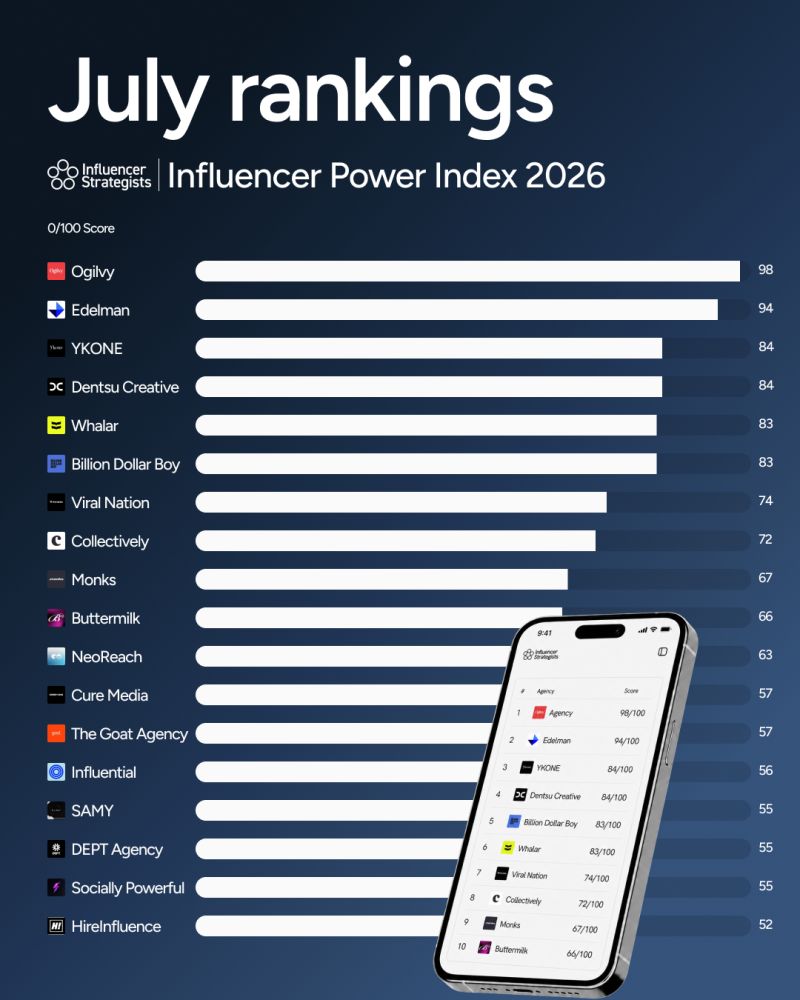
Influencer Strategists operates the Influencer Agency Index, the industry's non-pay-to-play ranking of influencer marketing agencies. The most recognized overview of the worlds most trusted Influencer Marketing Agencies.
One conclusion from this work frames everything else: the qualities that win pitches have almost no correlation with the qualities that produce results. Pitches select for polish, logo walls, and case study curation. Performance is driven by strategic capacity, accountability infrastructure, consumer intelligence, and the specific individuals on your account. None of these are visible in a standard pitch. All of them are testable. This guide gives you the tests.
Your problem right now when you are assessing Influencer Marketing Agencies
If you are evaluating agencies right now, your research process has probably already failed you in four specific ways. We hear the same sequence from nearly every brand that engages us:
The four dead ends of standard agency research
Google search | Pay-to-play rankings. Position reflects marketing budget, not delivery. |
AI search | The same names again. AI inherits the same undifferentiated directory layer. |
Case studies | Curated wins, measured inside the campaign window, no failures shown. |
Review platforms | Ten reviews at most, all reading alike, shaped by review-acquisition pipelines. |
The public information layer in this industry genuinely cannot discriminate between candidates. Discrimination requires a different instrument.
The two-level evaluation model
The framework we use with client brands separates two questions that buyers usually blur into one. Level 1 asks: is this a strong agency in absolute terms? Level 2 asks: is this the right agency for us? Strong agencies can be wrong fits. Weaker agencies can occasionally be right ones. Conflating the two questions is the most common structural error in agency selection.
The two-level evaluation model
LEVEL 1 | SCREEN THE MARKET |
Creative depth: concepts that could not be swapped between brands. Client impact: commercial metrics headlined, with an attribution story. Recognition: read in context, never used as a filter. Revenue trajectory: controlled growth, high retained share, no hesitation when asked. |
LEVEL 2 | DIAGNOSE THE FIT |
A consumer-community research process that precedes creator selection. Five creators in your category named from memory. KPIs that connect to the P&L. Targets and cadence committed pre-signature. Named individuals including the creative lead, protected by a key-person clause. An unprompted idea with a documented result. Evidence that a past campaign's impact outlived the campaign. |
PROTECT THE DECISION |
Six contract clauses. Forensic testimonial read. Artifacts, not narratives. The longest-tenured reference call. A deep onboarding pack, internal SLAs, one empowered owner, realistic timelines, and a standing demand for A/B proof. |
The best agency on your shortlist makes your onboarding harder, commits to numbers before you ask, names your consumers' communities before it names a single creator, and can prove its impact outlived its last campaign. Friction in the right places is the strongest quality signal in agency selection.
Level 1 uses the same four dimensions as the Influencer Power Index, which means you can shortcut part of it: the index already scores the market. Level 2 cannot be shortcut, because fit is specific to your brand, your category, and your operating model. The remainder of this guide walks through both levels, then the verification, contract, and buyer-side layers that protect the decision.
Creator identification and workflow no longer justify a premium
The most-circulated selection guides in this space still rank creator identification capability, workflow management, and roster access as the primary criteria. A decade ago that ranking was correct: finding the right creators was hard, and managing fifty simultaneous creator relationships was an operational achievement. AI has ended that era. Discovery and workflow are being commoditised at every level of the market, from solo consultants running AI-assisted stacks to enterprise platforms vetting audience quality in seconds. Evaluating an agency primarily on this machinery in 2026 means evaluating it on the part of its service with the shortest remaining shelf life.
The differentiation is concentrating in what cannot be automated: strategic capacity, the quality of thinking about which consumers to reach and why, and creative capacity, the ability to produce work distinctive enough to earn attention rather than rent it.
The criteria stack has inverted
↓ COMMODITISED BY AI Creator identification & discovery Campaign workflow management Roster access & platform tooling Table stakes. Do not pay a premium. | ↑ COMMANDS THE PREMIUM Strategic capacity Creative capacity Earned growth systems The scarcity. Weight your evaluation here. |
Earned growth systems: the criterion we now weight above the rest
Earned growth systems have become a major focus area of our advisory work, and the reasoning is financial before it is strategic. Three numbers describe the environment. Global advertising spend has grown 2.8x faster than global GDP over the past decade. 85% of ads fail to meet the 2.5-second attention threshold required to form memory. 94% of brand visibility in AI search results comes from non-paid sources. Bought attention costs more every year, retains less every exposure, and is invisible to the systems that increasingly mediate discovery. Brands are overpaying to compensate for ideas that do not travel.
Why systems outrank campaigns
2.8x Ad spend growth vs global GDP, past decade | 85% of ads fail the 2.5-second memory threshold | 94% of AI search visibility comes from non-paid sources |
The implication for agency selection is direct. An organisation preparing to deploy seven-figure budgets into influencer marketing should require evidence that the agency thinks in systems: creator relationships that build durable community presence, content engineered for search and AI citation, and campaign architecture designed so impact compounds after the media stops. In our analysis of programme economics, this systems layer is almost always the difference between conventional and exceptional ROI in influencer marketing, because a campaign is an expense that ends while a system is an asset that compounds. The agency you select either engineers systems or produces one-offs, and few will volunteer which.
THE TEST
Ask every shortlisted agency: 'Take a campaign from more than a year ago and show me what remained six and twelve months after it ended: community presence, creator relationships, search and AI visibility, retained audience.' Then: 'How would you architect our programme so its impact compounds rather than expires?' Agencies that think in systems answer with architecture: always-on creator networks, owned community assets, durable discoverability. Agencies that think in campaigns answer with another campaign.
Screen the market on four dimensions
These are the four dimensions of the Influencer Power Index. Each is externally observable, which means you can score any agency without inside access, and each has a specific failure pattern it protects you from.
The four Level 1 dimensions and the question that tests each
Creative Depth Could this concept be swapped to another brand unchanged? | Client Impact Which metrics do their case studies actually headline? |
Industry Recognition Are awarded campaigns for retained clients, with commercial results? | Revenue Trajectory Is growth controlled, retained, and answered without hesitation? |
Creative depth: the interchangeability test
Read case studies for range, not polish. A strong portfolio shows distinct creative systems across clients: work that could only have been made for that brand, in that category, for that audience. A weak portfolio shows one mechanic redressed in different brand colours, the same giveaway structure, the same unboxing format, applied to a skincare brand, a fintech app, and a food chain. If you could swap the logos between two case studies and nothing else would need to change, the agency runs a production line. In the pitch, ask the creative lead to narrate the thinking behind one case study. Depth narrates reasoning. Polish narrates results.
Client impact: read the metrics they choose to headline
The metrics an agency celebrates are the metrics it optimises for. Case studies headlined by impressions, reach, and engagement volume describe distribution. Case studies headlined by sales lift, cost-per-acquisition, or retention describe business impact. Watch for the substitution pattern: a case study that opens with 'the brand needed to drive sales' and closes with '40 million impressions' has quietly replaced the meaningful with the measurable. Run inside your engagement, that substitution is the most expensive failure in the industry: every number in the report rises while the business outcome stays flat. Ask for one case study where a commercial metric moved, and make them walk you through the attribution.
Industry recognition: a signal, never a filter
Awards correlate with creative ambition, and consistent recognition across years and juries demonstrates something real. But the signal is contaminated in both directions. Entering awards costs real money, entry fees, case study films, submission craft, and many excellent independents simply do not allocate the budget; their absence measures marketing spend, not work quality. Meanwhile some agencies engineer campaigns for jury appeal rather than client outcomes. Read recognition in context: awarded campaigns for retained clients with commercial results attached are genuine signals. An agency with no awards but decade-long client tenures has proven the same thing a different way.
Revenue trajectory: the dimension buyers challenge us on, and we hold
An agency's own revenue growth belongs in your evaluation, and we weight it deliberately. Stable, increasing revenue is the compound output of everything else you are trying to measure: clients that renew, scopes that expand, referrals that arrive, and an operational framework that absorbs growth without quality collapsing.
Declining revenue is rarely just a sales problem. From inside agency organisations we have watched the mechanism: the agency fails to convert projects into retainers because delivery does not justify renewal. The decline then compounds operationally. Senior talent leaves for stability, remaining teams stretch across more accounts, quality drops further, the next renewal gets harder. By the time you meet the agency in a pitch, the discounted rate on the table is the visible symptom of that spiral, which makes it the most expensive discount in the market. Growth has its own failure mode: an agency growing faster than its operational framework can absorb shows the same quality symptoms from the opposite direction. The signal you want is controlled growth, revenue rising alongside headcount, retention, and delivery infrastructure.
THE TEST
Ask: 'How has your revenue developed over the past three years, and what share is retained versus project-based?' Private agencies rarely give precise figures; the shape of the answer is the signal. Healthy agencies discuss retention rates, multi-year clients, and controlled expansion without hesitation. Cross-check with observable proxies: headcount trajectory on LinkedIn, senior team stability, and whether the case study clients from three years ago are still clients today.
Diagnose brand fit with six tests
Level 1 identifies which agencies are strong. Level 2 determines which one is right for your organisation. Each test extracts a signal that the standard pitch process does not surface, and the full battery costs two meetings, one reference call, and one document request.
The six fit tests and the question that runs each
Consumer intelligence | Before proposing creators, how will you identify the consumer communities we need to reach? |
Category expertise | Name five creators you would shortlist for us, and why. |
Measurement standard | What KPIs will you commit to, and how does each connect to our revenue? |
Operating rhythm | What targets, at what cadence, in what format, delivered to whom? |
Individual Strategist | Who exactly will work our account? Introduce me, including the creative lead. |
Proactivity | Tell me about an idea you brought a client that was not in their brief. |
Consumer intelligence: the research process that precedes creator selection
The Precision Gap Report, co-authored with Sherry Wu at BCG, established that the agency functions as the de facto consumer intelligence layer for most brands. Where the agency provides detailed consumer tribe analysis, 89% of clients report strong consumer understanding and maintain their own research investment. Where the agency provides only demographics, or nothing, client confidence persists while the intelligence behind it falls to zero. The quality of consumer understanding available to your organisation will be substantially determined by this selection decision.
The distinction to evaluate is demographic matching versus precision targeting. Demographic matching overlays audience data onto creator data; it is the industry-standard process. Precision targeting identifies the consumer communities relevant to your category through primary research and social listening, maps their conversations and trust structures, and selects creators against that intelligence. BCG's pilot data puts the performance difference at 4-6x earned media efficiency. Both approaches produce creator shortlists. Only one produces the right audience.
The difference between a programme that returns $1M and one that returns $4M on the same budget is rarely the creators. It is the precision of the targeting decision made before any creator was contacted.
Industry and cateogry expertise
Creator rosters, negotiation relationships, content-format benchmarks, and audience-quality judgment are category-specific assets that do not transfer across verticals. The costliest selection error we have documented followed exactly this gap: a competent generalist executing in a category it did not understand, producing strong reach metrics with zero revenue impact, undetected for months because the reporting measured the wrong variable. The five-creators test resolves this in the first meeting: a category specialist answers from memory with audience-fit reasoning; a generalist commits to following up.
Measurement standard: determine at selection whether underperformance will be visible
An agency measured on reach can deliver reach in an audience that will never purchase, satisfy every reported KPI, and erode value for a full contract cycle before the gap surfaces. An agency measured on cost-per-acquisition is exposed within a quarter. The Precision Gap Report quantified how rare business-level measurement remains: 91% of influencer marketing teams track engagement rate; 9% track spend efficiency. Which side of that distribution your programme lands on is determined at contract, not at campaign. Request a sanitised sample report and assess two properties: whether performance is framed against competitive benchmarks or own-account figures only, and whether the report is legible to a CFO.
Operating rhythm: accountability infrastructure
The strongest engagements in our analysis share identical operating mechanics regardless of budget: numeric targets agreed pre-signature, weekly or biweekly reviews against a fixed agenda, monthly tracking against target, and reporting formatted for the client's leadership. Engagements that fail share the inverse profile, and the absence of infrastructure typically becomes undeniable only after two quarters of budget have been consumed. An agency that declines to commit to targets before signature is stating its preference to be evaluated on relationship quality rather than output. That response is itself decision-relevant data.
Key personnel: the individual strategist is a primary selection variable
Strategy quality, creator access, and budget judgment are attributes of individuals, not of the firm that employs them. In our evaluation work, the performance variance between the strongest and average strategist within a single agency frequently exceeds the variance between agencies. Our own operating position reflects this: were the key strategist on an engagement we run to leave the agency, we would initiate a review of the engagement itself, because the asset the fee was buying has materially changed.
This has a sequencing implication for the evaluation. The standard process starts with agency names and works down to teams; the more reliable process starts with practitioners and works up to their employers. The industry's leading operators are publicly identifiable: they publish their thinking, and LinkedIn has become the primary surface on which their reasoning quality can be assessed before any commercial engagement. For a growing share of buyers, evaluating an individual's published thinking is now the first step of the selection process, with the agency entering consideration through the practitioner. We maintain a directory of the leading experts across the industry's agencies at influencerstrategists.com/experts, built from the same evaluation work behind the Influencer Power Index. The decision should then be protected contractually: key personnel named in the SOW, with a key-person clause under which material team changes trigger a formal review rather than a silent substitution.
Proactivity: the agency's default operating posture
Across our evaluation work, a consistent differentiator between engagements that renew over multiple years and engagements that terminate within one is the agency's behaviour outside the brief: optimisations raised before the client identifies the issue, recommendations against approaches that will not work, and problems surfaced together with a remediation plan. Engagements that fail rarely fail through incompetence. They fail through passivity presented as service: high responsiveness, consistent availability, and no initiative, no timeline, no milestone structure, no recommendation that did not originate with the client. Responsiveness is observable in any sales process. Proactivity must be tested for deliberately, because a pitch is structurally reactive: the brief was issued, the agency responded. The historical question, an idea brought to a client outside the brief, with its context and result, is the most efficient instrument for extracting this signal in a first meeting.
Verify before you decide
Every claim made during evaluation can be checked, and the effort is trivial relative to contract value. Four checks close the gap between what you were told and what is true.
Read testimonials forensically. Check whether each review's content matches the reviewer's stated industry, whether phrasing repeats across supposedly independent reviews, and whether detailed verified reviews tell the same story as the short five-star ones. Weight depth and consistency over volume and rating.
Match review volume to company scale. A large agency with a high minimum and a handful of public reviews is not disqualified, but public evidence cannot carry diligence at that spend level. Thin base means mandatory reference calls at your tier.
Request artifacts. Sample reports, milestone documents, onboarding questionnaires, QA checklists. Real infrastructure produces them within a day. Narrated infrastructure stalls or improvises something visibly created for your request.
Call the longest-tenured client, and ask about failure. Not the reference they suggest; the client who has been there longest, who can tell you what year three looks like. On the call, one question above all: 'What does the agency do without being asked?' And to the agency directly: 'Walk me through your last engagement that went badly.' Real escalation processes narrate failure candidly. There is no good non-answer.
Contract architecture: five clauses plus one
Six contract provisions, each mapped to the failure it prevents
Deliverable-based payment gates | Prevents: paying for time while output quietly stops |
Targets and cadence in the SOW | Prevents: accountability that dissolves after signature |
Audience-quality definition | Prevents: growth in an audience that will never buy |
Account and tool ownership | Prevents: lock-in and margin built on your subscriptions |
Escalation contact + response SLA | Prevents: silence when things go wrong |
Key-person clause | Prevents: buying a strategist, receiving a substitution |
What the best agencies will expect from you
The strongest engagements are co-produced, and the highest-spending, longest-tenured clients in our research consistently credit their own contribution. If your evaluation is rigorous, expect the best agencies to evaluate you back. Five obligations sit on your side of the table: a deep, honest onboarding covering customers, competitors, positioning, voice, and compliance, because generic output is co-produced by thin briefs, and a demanding intake process from the agency is itself a positive signal; internal approval SLAs that match the cadence you demand from them; one internal owner with decision authority; launch plans built on realistic creator timelines, three to six weeks from kickoff to first live content is normal, and any agency promising materially less is inexperienced rather than fast; and a standing demand for comparative testing of agency creative against your incumbent assets, written into the working rhythm from day one.
Frequently asked questions
1. How do I choose the right influencer marketing agency?
Use a two-level evaluation. Level 1 screens the market on four externally observable dimensions: creative depth (could their case study concepts be swapped to another brand unchanged?), client impact (which metrics do their case studies actually headline?), industry recognition (read in context, never used as a filter), and revenue trajectory (controlled growth with a high retained share). Level 2 diagnoses fit for your specific brand through six tests covering consumer intelligence, category expertise, measurement standards, operating rhythm, key personnel, and proactivity. The full battery costs two meetings, one reference call, and one document request.
2. What is the most important question to ask an influencer marketing agency before signing?
"Before proposing any creators, how will you identify the consumer communities our campaigns need to reach?" This is the test almost no buyer runs, and it separates the top tier of the industry from everyone else. An agency operating from consumer intelligence describes a research process: community identification, conversation mapping, tribe profiling, then creator selection. An agency operating from a database describes filters. BCG's research puts the performance difference between these two approaches at 4-6x earned media efficiency on the same budget.
3. Are agency awards and Clutch reviews reliable indicators of quality?
Treat both as signals, never as filters. Awards are contaminated in both directions: entering costs real money that many excellent independent agencies do not allocate, while some agencies engineer campaigns for jury appeal rather than client outcomes. Review profiles are shaped by review-acquisition pipelines, and volume across the entire category is thin. The hardest evidence to manufacture is multi-year client retention. Ask for a reference call with the agency's longest-tenured client, not the reference they suggest, and ask that client one question above all: "What does the agency do without being asked?"
4. What KPIs should an influencer marketing agency commit to?
KPIs that connect to your P&L: cost-per-acquisition, ROAS, qualified leads, direct bookings, with audience-quality reporting on every creator selection. An agency measured on reach can deliver reach in an audience that will never purchase, satisfy every reported number, and erode value for a full contract cycle before the gap surfaces. Our Precision Gap Report, co-authored with BCG, found that 91% of influencer marketing teams track engagement rate while only 9% track spend efficiency. Which side of that statistic your programme lands on is decided at contract, not at campaign.
5. How do I know if an agency will deliver long-term ROI, not just one strong campaign?
Ask for evidence that a past campaign's impact outlived the campaign: "Take a campaign from more than a year ago and show me what remained six and twelve months after it ended — community presence, creator relationships, search and AI visibility, retained audience." Agencies that engineer earned growth systems answer with architecture: always-on creator networks, owned community assets, content built for durable discoverability. Agencies that think in campaigns answer with another campaign. In our analysis of programme economics, this systems layer is almost always the difference between conventional and exceptional ROI in influencer marketing, because a campaign is an expense that ends while a system is an asset that compounds.