The massive Social Search opportunity in Influencer Marketing
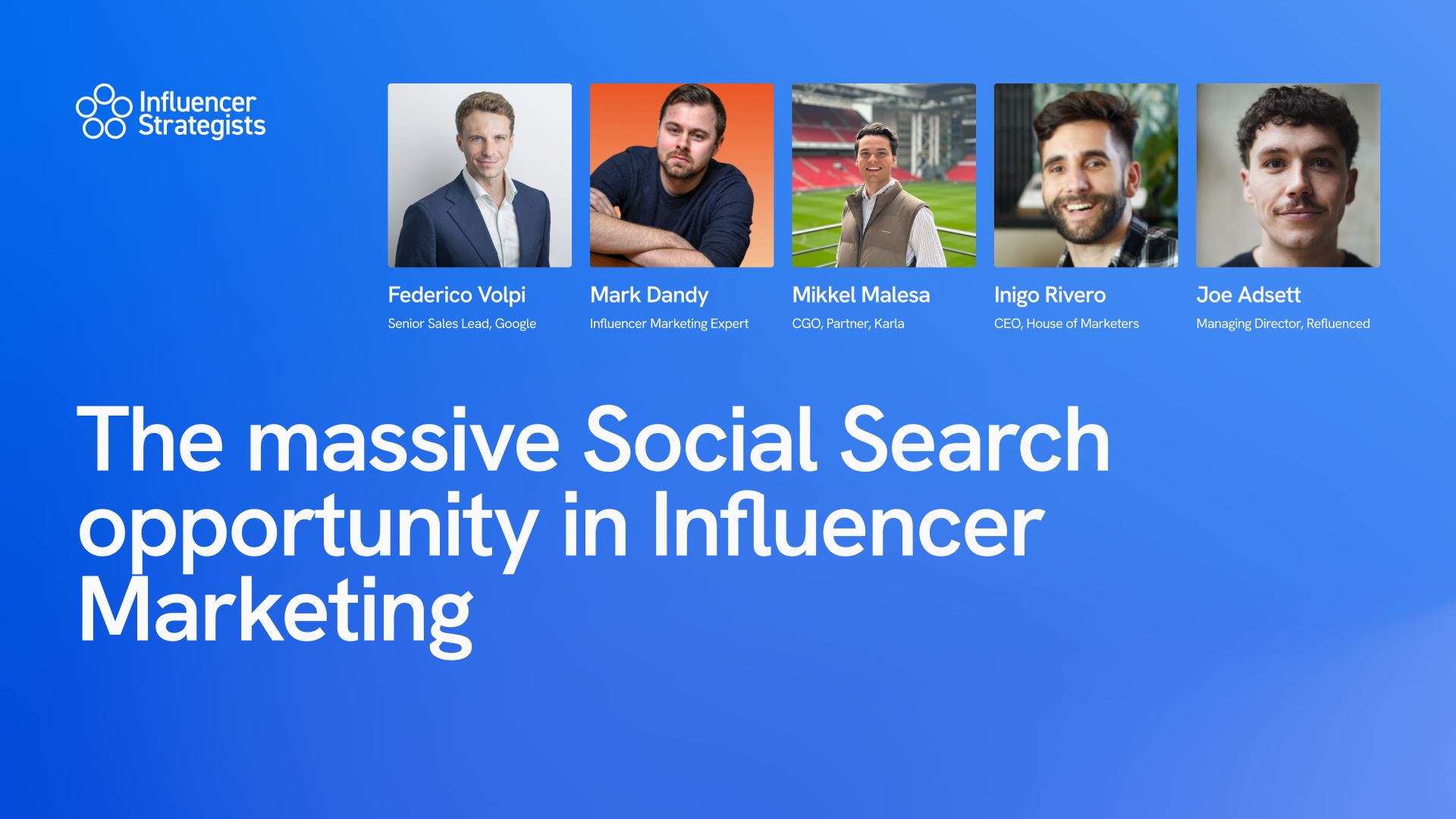
This panel makes the case that influencer marketing is becoming a performance channel, powered by social search. As traditional SEO fragments, consumers increasingly discover and research products on TikTok, Instagram and YouTube, then return to Google or an AI tool to convert. Five practitioners weigh in: Federico Volpi (Senior Sales Lead, Google), Mark Dandy (influencer marketing expert), Mikkel Malesa (CGO and Partner, Karla), Inigo Rivero (CEO, House of Marketers) and Joe Adsett (Managing Director, Refluenced). They cover how the buyer journey now works, why social is both a search engine and a source of answers, and the tactics for ranking in it, from keyword-led briefs to working with creators at volume. The figures and frameworks below capture where the opportunity sits heading into 2026.
Key highlights
Federico Volpi of Google described the buyer journey as a relay race across platforms: social sparks inspiration, video adds depth, AI handles specific research, then the purchase still mostly returns to Google or Bing.
Federico Volpi noted Google's AI Overviews already reach about 2 billion users a month after launching this year, and 50% of YouTube views now happen on TV screens.
Session data framing the shift: over half of Gen Z find products most often on Instagram and TikTok versus just 18.8% on Google, 57% already use YouTube to search for information, and 84% of TikTok searches happen in the discovery phase.
Joe Adsett of Refluenced flagged July 10th as a turning point, when Instagram joined YouTube, LinkedIn and Pinterest in being indexed by search engines, moving social search from innovators into the early-adopter phase for 2026.
Joe Adsett: 64% of Gen Z now turn to TikTok over a traditional search engine, and social is not just a search engine but a source of answers, creating a compounding discoverability effect.
Mikkel Malesa of Karla built 50% of his platform's traffic from TikTok search by mining comment sections for the questions viewers asked, then making videos that answered them, with clips from 2022 still pulling views.
Mark Dandy explained that algorithms now rank interest over individuals, so following a travel creator signals interest in travel rather than the person, reshaping feeds around topics and priming social for search.
Mark Dandy proved the point on his own 2,300-follower TikTok: 100,000 views in 28 days with 40% from search, and one video that climbed from roughly 700 views to 32,000 and rising 1,000 a day once it ranked.
Inigo Rivero of House of Marketers shared a five-step social SEO framework: identify the search query, understand intent, pick a format that answers it, give creators a menu of formats rather than a rigid script, and make the hook reflect the query.