What Brands Need to Know Before Testing TikTok Live
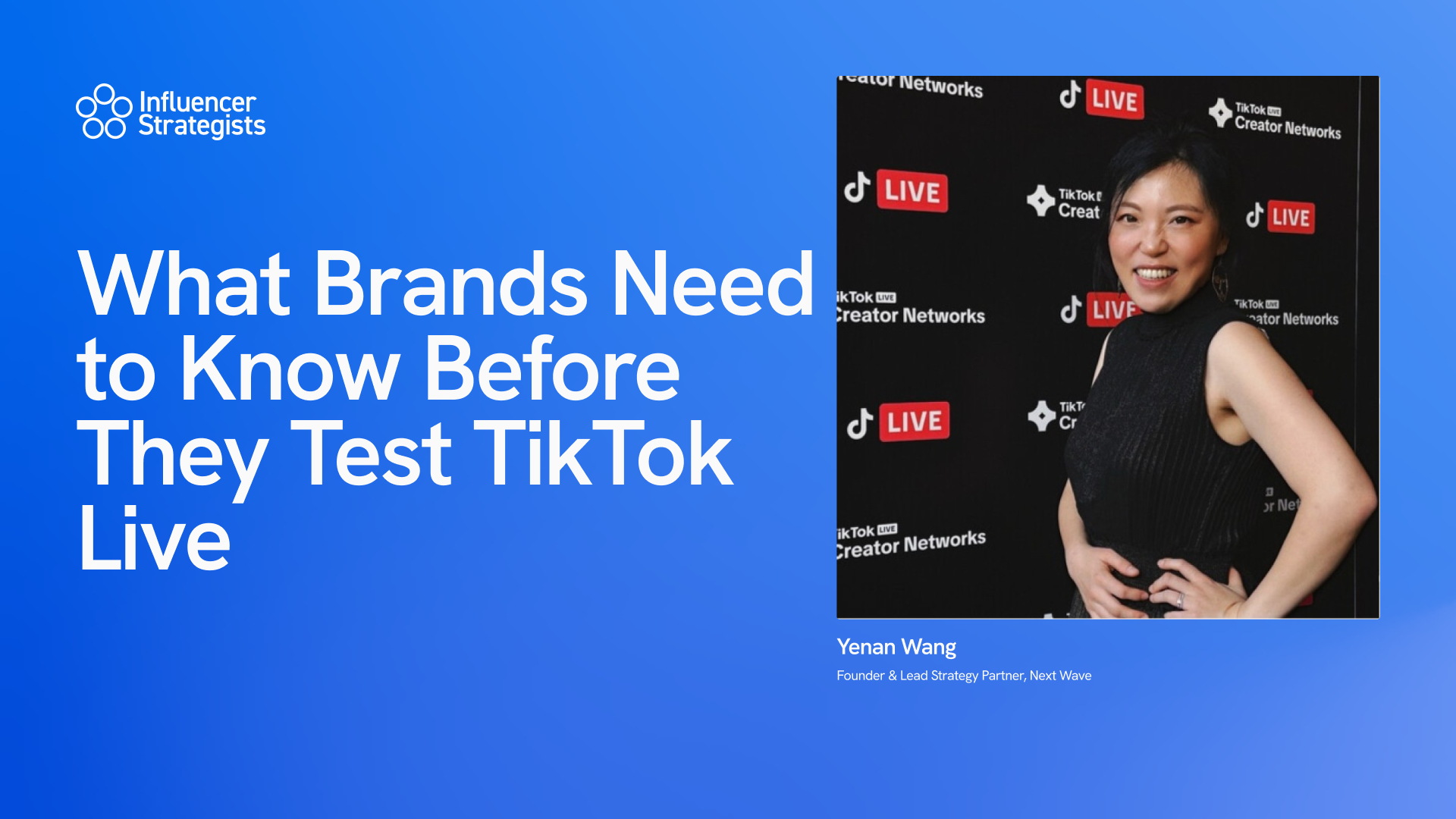
Plenty of brands have tried TikTok Live, decided it either worked or did not, and could not say why. In this Influencer Strategists session, Yenan Wang, who previously worked at TikTok and now runs the growth consultancy Next Wave, explains why Live behaves unlike any other format and what brands need in place before they test it. Her core argument is that Live is a behavior-driven learning system, not a one-off broadcast: the platform rewards rooms where people stay and interact, polish and follower counts barely matter, and the real value is as a decision accelerator for products that need explaining. The highlights below pull out the mechanics, the evolution, and the brand examples she walked through.
Key highlights
Most TikTok Live tests fail not because of the wrong creator or product, but because brands run a single session and expect a clear answer too quickly, when Live behaves like a learning system that only reveals itself over repeated streams.
Live is not QVC: viewers drop in with questions rather than watching a one-way presentation, so what holds them is whether the host notices them and answers, not how polished the setup is.
Follower count is a weak signal in Live. Large creators, including ex-Love Island names, often struggle because they treat it as a performance, while smaller, highly interactive hosts hold attention far better.
Three platform facts: Live drives significantly longer viewing time than edited video, retention rather than budget is what pushes a session into the For You feed, and Live connected to TikTok Shop consistently converts much higher than running ads alone.
TikTok's evolution explains the shift: a content-discovery engine in 2018, trusted creator personalities emerging around 2020, Live scaling into significance between 2020 and 2022, and Live now functioning as commerce infrastructure where creators act as operators guiding journeys.
Every Live starts with a small amount of complimentary traffic, and the system expands or slows reach based on whether viewers stay and interact, so behavior is what unlocks distribution, the reverse of the reach-first thinking in short form.
Live wins for higher-consideration products that need explanation: Samsung's recent UK Live compares phone models on camera, Air China and China Eastern on Douyin answer routes and ticket questions in public where one question is heard by 100 other viewers, and Philips demos reduce post-purchase returns.
Brands can start small without polish: Sweden's plant retailer Blomsterlandet went live holding up barcodes printed on paper and turned the session into a plant-advice counter, which lifted customer retention rather than replacing e-commerce.
The best Live hosts often are not influencers but people from retail floors and call centers, including one standout presenter who was a car-insurance call-center agent, so brands should hire for who already handles questions and uncertainty all day.
Professional Live studios are maturing quickly: operations Wang visited in Hangzhou, China fill 15 to 20 floor buildings with training and production teams and 5 to 6 staff monitoring each stream, and similar full-time studios are now emerging in the UK and Romania.